
How Travel Advisors Are Embracing Agentic AI

After speaking at Virtuoso Canada’s conferences in Toronto, Vancouver, and Calgary, one thing became very clear: Travel advisors are not afraid of AI.
They are curious. They are practical. They are asking better questions. And most importantly, they are beginning to understand that Agentic AI may become one of the most powerful tools they have ever had to grow their business, serve clients better, and reclaim time from repetitive work.
During my keynote series with Virtuoso Canada, I spoke about the key technology and marketing trends transforming Canadian luxury travel in 2026. The conversations afterward were even more revealing than the presentation itself.
Advisors came up afterward with real examples of where AI was already helping them: drafting client emails, summarizing supplier policies, creating social content, building itineraries, preparing proposals, and researching destinations faster than ever before.
But the biggest point I was keen to convey was this:
Generative AI creates content.
Agentic AI takes action.
That is the shift travel advisors need to understand.
🞚 From AI That Creates Content to AI That Makes Decisions
Over the past year, most advisors have experimented with AI in some way. Some have used ChatGPT, Claude, or Gemini to draft emails. Others have used it to build newsletters, summarize trip notes, brainstorm social posts, or create first-pass itineraries.
That is useful.
But Agentic AI moves beyond answering questions. It can begin to reason, make decisions, interact with tools, monitor information, and complete tasks across workflows.
For travel advisors, that means AI is no longer just a writing assistant. It can become an always-on junior assistant.
That assistant can help with:
Preparing proposal outlines
Summarizing supplier contracts and policies
Organizing CRM notes
Monitoring weather disruptions
Watching for flight delays
Flagging safety or political updates
Suggesting proactive alternatives
Creating social media and email marketing content
Supporting itinerary planning and research
The advisor still leads. The advisor still verifies. The advisor still owns the relationship.
But AI can remove enormous amounts of repetitive, low-judgment work.
🞉 Why Advisors Are Especially Well Positioned
One of the key points from my Virtuoso keynote was that travel advisors may be one of the best-positioned professions to benefit from both Generative AI and Agentic AI.
Why? Because the advisor role is already a mix of research, personalization, communication, coordination, and trust. Those are exactly the areas where AI can help.
Before AI, an advisor might spend three hours building an itinerary, manually drafting emails, and repeating research across multiple clients.
With the right AI workflow, that same process can often become a 20-minute starting point with higher-quality output and more time available for the client relationship.
That does not mean replacing the advisor. It means giving the advisor leverage.
The best advisors are not going to win because they use AI to become generic. They are going to win because they use AI to create more space for the things that make them irreplaceable:
Taste. Judgment. Trust. Relationships. Insider access. Crisis handling. Human connection.
🞜 What Advisors Told Us After the Keynotes
The most encouraging part of the Virtuoso Canada sessions was the reaction from advisors afterward.
Many were not asking whether AI mattered. They were asking how to start.
Some wanted to know which platform to use first. Others wanted to know how to write better prompts. Several asked how to use AI without losing their personal voice. A few were already thinking about building custom tools around their own brand, client notes, preferred suppliers, and marketing style.
That is the right mindset. Start small, build confidence, then scale.
For most advisors, the first step is not building a complicated AI system. It is choosing one platform and using it consistently.
Start with ChatGPT, Claude, or Gemini. Use a paid account if possible. Then learn the basics of prompting.
A good prompt includes:
Context
Client type
Goal
Constraints
For example:
“Create a 7-day luxury Japan itinerary for a honeymoon couple, including unique cultural experiences, high-end hotels, and a relaxed pace.”
That one prompt is not the final answer. It is the beginning of a better workflow.
The Agentic AI Series:
9 Travel Minds on
Where This Is Headed
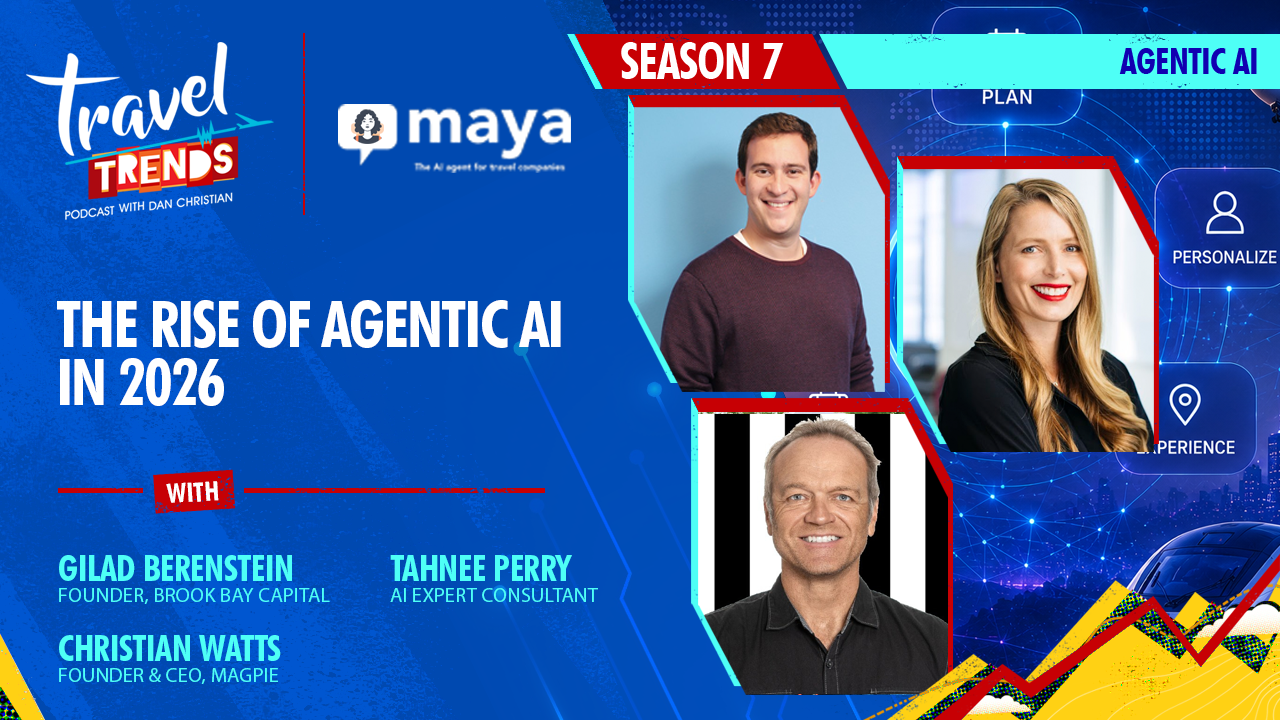
This topic has also been central to our three-part Agentic AI series on the Travel Trends Podcast, where we brought together nine of the top minds in travel to explore where Agentic AI is being applied now and where it is headed next.
Across the series (sponsored by our friends at Mayatravel.ai), a few themes kept coming up.
First, the real shift is from AI that writes to AI that gets things done.
Second, the biggest early value is not replacing people. It is removing friction.
Third, trust matters more than ever. AI systems must be grounded in real data, connected to accurate content, and designed with human handoffs when needed.
Fourth, the future traveler journey will be shaped by conversation, memory, personalization, and intelligent recommendations.
Finally, the companies and advisors that move early will gain an advantage by learning what works before everyone else catches up.
Agentic AI will affect discovery, planning, quoting, booking support, customer service, marketing, operations, and post-trip engagement.
But the most important opportunities for advisors are likely behind the scenes.
⦿ The Real Opportunity Is the Back Office
There is a lot of conversation about AI chatbots replacing travel planning. That is not where advisors should focus first. The bigger opportunity is powering the back office.
Think of AI as a junior team member that can support many functions but still needs guidance. It works fast, improves with better instructions, and can be trained around your preferences, tone, suppliers, and workflows.
At the beginner level, advisors can use AI for email drafting, itinerary creation, social posts, newsletters, and brand marketing.
At the intermediate level, advisors can create a CustomGPT or similar assistant to centralize their knowledge, maintain consistent brand voice, and personalize marketing at scale.
At the advanced level, advisors can begin experimenting with AI agents that interact with files, systems, calendars, CRMs, supplier documents, and client records to help complete business tasks.
❀ Don’t Lose the Human Touch
Here is the good news. In an AI-saturated world, trust and authenticity will matter even more. As more content becomes AI-generated, travelers will become more skeptical of generic recommendations, generic itineraries, and generic destination advice. That gives great advisors a major advantage.
The advisors who win will be the ones who combine AI-powered efficiency with deeply human storytelling, relationship building, insider access, and curated expertise.
AI can help you move faster. But your voice, your taste, your network, and your judgment are still the differentiators. The question is not simply: “Can you use AI?” The better question is: “Where should you use AI, and where should you stay deeply human?”
▶ Where Advisors Should Start Now
For any advisor wondering how to begin, here is the simplest path:
Choose one AI platform.
Use it every day.
Start with marketing, email drafting, and itinerary outlines.
Create reusable prompts.
Verify everything.
Protect client data.
Keep your human voice.
Then, as you become more comfortable, start thinking about where AI can support your actual workflow: CRM notes, supplier information, proposal creation, follow-ups, disruption monitoring, and client communication.
Do not wait until the tools are perfect.
Start embracing them now.
⬤ Beyond AI:
What Comes Next
Agentic AI is only one piece of a much larger transformation happening across the travel industry.
That is why we are expanding the conversation at Travel Trends Summit V3: Beyond AI.
Our Summit is now live for registration and will bring together leaders from across the global travel industry to explore what is next across AI, emerging technology, distribution, revenue strategy, marketing, partnerships, and the future of building and scaling travel companies.
If you are a travel advisor, this is your opportunity to get ahead of where the industry is going next.

» Register now for Travel Trends Summit V3: Beyond AI:
https://www.traveltrendspodcast.com/travel-trends-summit-2026
The advisors who embrace AI thoughtfully will not become less human. They will become more available, more responsive, more creative, and more valuable to their clients. That is the real promise of Agentic AI. And we are just getting started.